
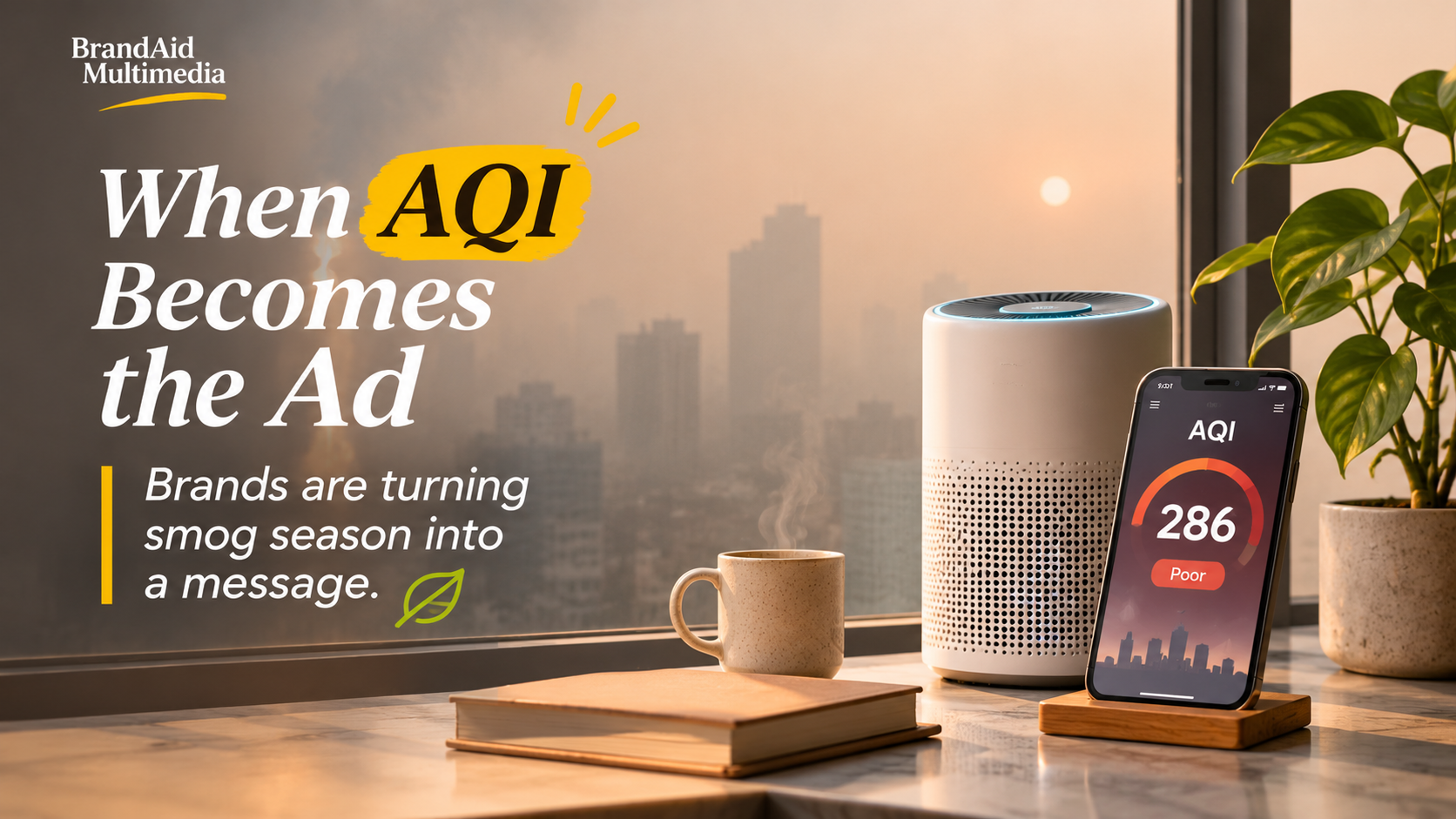
Air quality marketing has become a season of its own. Every November, as smog settles over Delhi and Mumbai, brands find a reason to talk about the air.
This month, two campaigns caught our eye.
One billboard that changes with the pollution.
One breakup that isn’t about a couple.
Both are smart. Both also walk close to a line most brands only notice after they have crossed it: the line between helping people and scaring them into a purchase.
What Happened This Smog Season
Ascenta, a real estate developer focused on second homes and nature-led communities, launched Breathe Green, Live Better, a real-time digital out-of-home campaign. The outdoor ads change with the prevailing Air Quality Index, so the message responds to the air people are actually breathing. The campaign points homebuyers towards greener locations such as Karjat and Khalapur along Mumbai’s 3.0 growth corridor. Karan Bahl, Founder and Director of Ascenta, said that while air purifiers are becoming a household necessity, people also need to think about how and where they choose to live.
Around the same time, Eureka Forbes released Break Up with Toxic in 10 Mins for its Aeroguard air purifier. Actors Barkha Singh and Ayush Mehra play what looks like a couple calling it off, until the twist reveals they are breaking up with toxic indoor air. The film carries the brand’s claim that the purifier removes toxic air in 10 minutes. It also made exchange4media’s Hit or Miss round-up of the week’s ads on 21 November.
Why This Air Quality Marketing Works
1. Ascenta Made the Billboard Read the Room
A static hoarding says the same thing on a clear day and a grey one. An AQI-linked screen doesn’t.
We think this is the most interesting part of the idea. The city’s own data becomes the creative trigger, so the ad feels like a reply to today, not a line written months ago.
It also fits the product. A developer selling open, green land has a genuine reason to talk about air. That relevance is what stops it looking opportunistic.
2. Eureka Forbes Chose a Laugh Over a Lung X-Ray
Purifier advertising has often leaned on grim imagery. Eureka Forbes went the other way and borrowed the language of toxic relationships, which younger audiences already use every day.
Our view: humour makes a worrying subject watchable, and a breakup is easy to remember. Anurag Kumar, Chief Growth Officer at Eureka Forbes, said the aim was to make indoor air quality relatable and memorable. On that brief, the idea delivers.
3. Both Brands Have a Real Role in the Problem
This is the test we would apply to any air quality marketing brief. Ascenta offers a different place to live. Eureka Forbes offers a device for the room you are sitting in. Neither is pretending that a biscuit or a phone will clean your lungs.
We would go further: if your brand cannot explain its role in the problem in one sentence, stay out of the AQI conversation. It is the same reason the No Bang Diwali campaign worked for a pet brand. The problem was one its customers already felt.
Where We Would Be Careful: The Fear-Selling Line
Pollution is a real worry, especially for families with young children and ageing parents. That is exactly why it is so easy to exploit.
A few cautions:
- No results have been shared in what we read. No sales, footfall or enquiry numbers. We can say these campaigns are well made. We cannot yet say they worked.
- A “10 minutes” promise is the brand’s own claim. Buyers will rightly ask for which room size and in what conditions.
- Live AQI creatives can backfire. On a hazardous day, a cheerful property ad next to a red number can feel like profiting from a bad day.
- A second home outside the city is not an answer for most people living in it. Messaging that hints “move away or suffer” can feel tone-deaf.
Fear sells once. Trust sells every season.
What Marketers Can Learn From Air Quality Marketing
- Earn the right to speak. Tie the message to what your product actually does.
- Set rules for live data. Decide in advance what the creative says when the AQI turns severe, and consider dropping the sales line on the worst days.
- Lower the panic, raise the clarity. Give people one useful thing they can do today.
- Put plain-language conditions next to every health claim.
- Plan for the season. Smog returns every winter, so build the idea once and refresh it each year.
Final Thoughts on Air Quality Marketing
The air will be in the news again next winter, and the one after that. Brands that show up with a real role, honest claims and a little warmth will be remembered. Brands that only show up with a scary number will be scrolled past.
The best air quality marketing doesn’t sell fear. It sells a way to breathe easier.
Want a campaign that responds to the moment without exploiting it? Talk to our team.