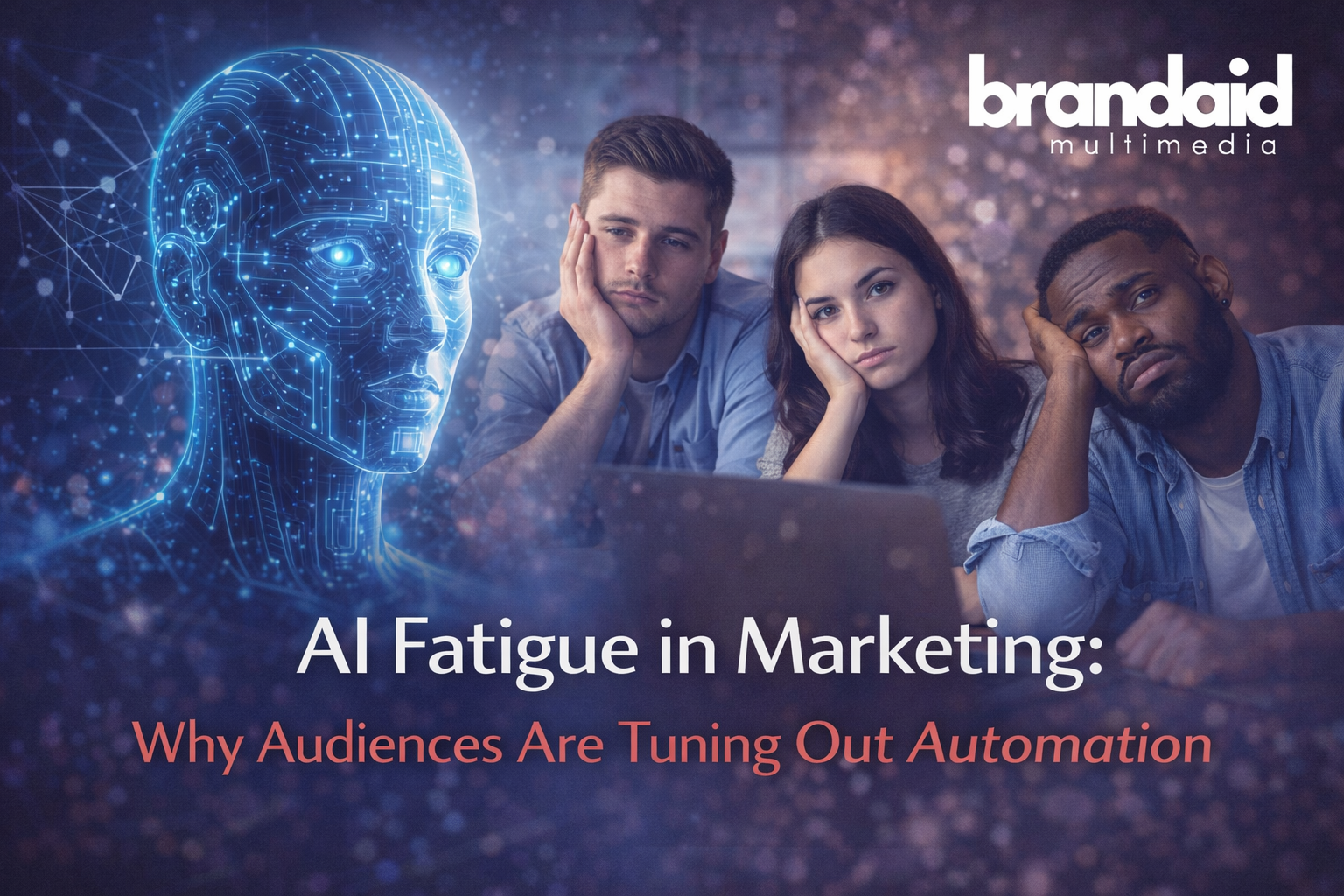
AI has changed how marketing is created, distributed, and scaled. Content is faster to produce, campaigns are easier to optimise, and automation is everywhere.
Yet despite all this efficiency, something unexpected is happening — audiences are disengaging.
This growing disconnect has a name: AI fatigue in marketing.
People aren’t rejecting technology. They’re rejecting content that feels repetitive, impersonal, and emotionally empty.
What Is AI Fatigue in Marketing?
AI fatigue in marketing occurs when audiences become overwhelmed or indifferent to content that feels automated, predictable, or generic.
It shows up when:
- Content sounds polished but soulless
- Messaging feels identical across brands
- Personalisation feels mechanical, not meaningful
- Volume increases, but the connection disappears
As a result, people scroll faster, engage less, and trust less.
Why AI Fatigue Is Growing So Fast
AI adoption happened quickly — faster than most brands paused to ask why they were using it.
Instead of supporting a strategy, AI often replaces thinking. Brands began prioritising speed over substance and quantity over clarity.
Consequently:
- Feeds filled up with similar formats
- Language became interchangeable
- Brand voices started blending into one another
When everything sounds “right,” nothing feels real.
Automation Isn’t the Problem — Overuse Is
AI itself isn’t the enemy. In fact, when used intentionally, it can enhance creativity, insight, and efficiency.
However, AI fatigue in marketing sets in when:
- Automation replaces human judgment
- Templates replace storytelling
- Data replaces empathy
Audiences don’t mind that brands use AI. They mind when brands stop sounding human.
How AI Fatigue Is Impacting Brand Perception
Fatigue doesn’t just reduce engagement — it affects credibility.
When content feels automated, people subconsciously question:
- Authenticity
- Effort
- Intent
Over time, this weakens the emotional connection. Brands may still be visible, but they stop being memorable.
In a crowded digital landscape, sameness is far more damaging than silence.
The Return of Human-Centred Marketing
As AI fatigue rises, audiences are gravitating back toward brands that feel real.
They respond to:
- Honest storytelling
- Imperfect but genuine communication
- Strong points of view
- Emotional relevance
Human insight stands out because it cannot be replicated perfectly by machines.
How Brands Can Use AI Without Causing Fatigue
The solution isn’t to abandon AI — it’s to reposition it.
Brands can reduce AI fatigue in marketing by:
- Using AI to support ideation, not replace it
- Editing content through a human lens
- Prioritising clarity over volume
- Protecting a distinct brand voice
- Creating content with intent, not obligation
AI should accelerate thinking, not substitute it.
The Brands That Will Win the AI Era
The future doesn’t belong to brands that automate the most.
It belongs to brands that balance intelligence with empathy.
Those who:
- Combine technology with emotional insight
- Use data to inform, not dictate
- Remember that people connect with people
AI will continue to evolve. Human attention will remain limited.
Final Thought: Just Because You Can Create More, Doesn’t Mean You Should
AI has given brands incredible power. But power without intention leads to noise.
AI fatigue in marketing is a signal — not of failure, but of excess.
The brands that listen, slow down, and choose meaning over momentum will stand out in a world full of automated content.
Because in the end, relevance isn’t created by machines — it’s felt by humans.